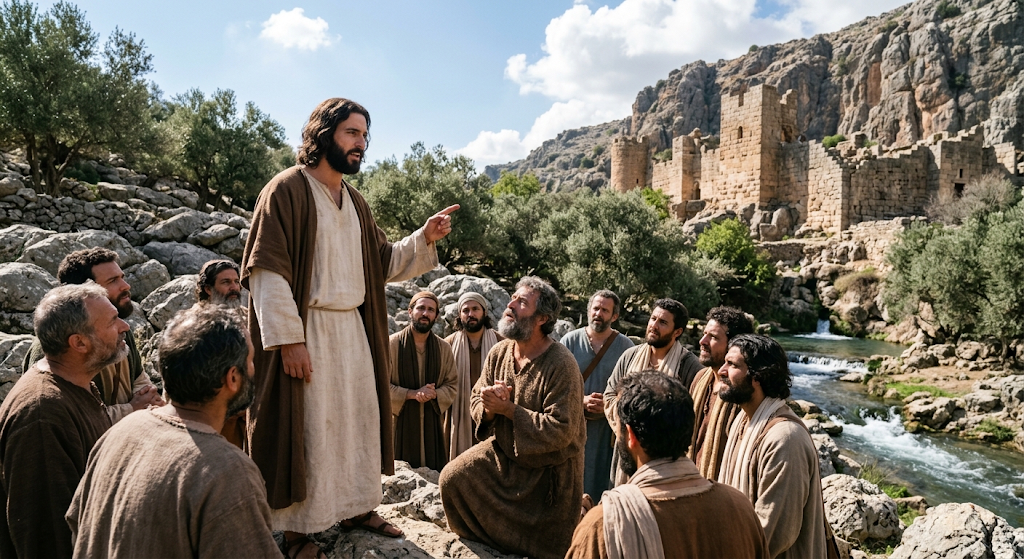
 There is something striking about the journey Jesus makes with his disciples before asking one of the most important questions in the Gospels: “But you, who do you say that I am?”
Matthew tells us that Jesus and his disciples travelled from the familiar surroundings of Galilee towards Caesarea Philippi, in the region around Mount Hermon.
For a modern visitor, the landscape can be imagined in relation to the Golan Trail, a modern hiking route that runs for roughly 75 miles. Of course, Jesus and his disciples were not following this modern trail, but it gives us some sense of the scale and character of the landscape through which they travelled.
Their journey northwards took them away from the familiar villages and shoreline of Galilee and into a very different environment. It was more than simply a change of scenery. This physical journey became part of a spiritual awakening.
A Place of Competing Claims
Caesarea Philippi was very different from the communities around the Sea of Galilee where Jesus had spent much of his ministry. It was associated with pagan worship, particularly the sanctuary of the god Pan. The great rock face and cave there were connected in the ancient imagination with the underworld. At the same time, the city bore the name of Caesar, representing Rome’s authority and power. It was therefore a place filled with competing claims… claims about the gods, political power and who deserved human allegiance.
And it is precisely here that Jesus asks his disciples who they believe he is.
First he asks: “Who do people say that the Son of Man is?” They give him the answers they have heard: John the Baptist, Elijah, Jeremiah or one of the prophets.
Then Jesus changes the question: “But you, who do you say that I am?” The question is no longer about what other people think. It is personal.
Peter responds: “You are the Christ, the Son of the living God.” Peter has moved beyond simply repeating what he has heard. He is beginning to recognise Jesus for who he truly is.
From knowing about Jesus to really knowing Jesus
The disciples had already seen Jesus teach, heal, forgive sins, calm storms and feed the crowds. They knew what he could do. Now they are being asked to recognise who he is.
Pope Benedict XVI reflected on this distinction, noting that people can recognise Jesus as an important moral or spiritual figure while still failing to recognise his uniqueness. That distinction remains important today.
Many of us first encounter Jesus through others. We learn about him from our parents, families, teachers and the Church. We learn the stories, prayers and teachings of our faith. But there comes a point when faith can no longer remain simply something we’ve inherited. We have to encounter the question for ourselves:
“Who do I say that Jesus is?”
This doesn’t mean abandoning what we have been taught. Rather, it means allowing what we have received to become a living faith — moving from simply knowing about Jesus to knowing Jesus.
Recognition Leads to Mission
Peter’s confession does not end the conversation. Jesus immediately gives him a new responsibility: “You are Peter, and on this rock I will build my Church.” Peter’s recognition of Christ leads to mission.
Encountering Christ is not simply an inward experience. It changes how we live and how we relate to others. Faith leads outward — towards service, community and responsibility. We should have confidence in what we believe. Being open to others does not require us to abandon our convictions, nor does disagreement require hostility.
Perhaps the better question is not simply: “How can I convince you that I am right?” but: “How can we help one another draw closer to Christ?”
If we truly recognise Christ, then our faith should influence not only what we believe, but how we listen, how we speak, how we serve and how we treat others.
The Journey Continues
Matthew’s Gospel does not leave the disciples at Caesarea Philippi. Their journey continues to another mountain, where Peter, James and John witness the Transfiguration of Jesus and glimpse his glory.
The disciples who have just confessed “You are the Christ, the Son of the living God” are given a deeper revelation of who Jesus is.
Faith is rarely a single moment of complete understanding. We may recognise something of Christ and yet discover that there is always more to learn, more to surrender and more deeply to receive.
The journey continues.
And perhaps that is where Caesarea Philippi speaks to us today. We too live among competing claims — about power, success, identity, truth and what gives life meaning. The question Jesus asks has not changed: “Who do you say that I am?” It is not merely a question requiring the correct theological answer. It is an invitation to consider our own relationship with Christ.
Have we moved from simply knowing about Jesus to knowing Jesus? Has our faith changed the way we live? Has recognising Christ changed the way we serve?
Peter’s confession was not the end of his journey. It was the beginning of a life of discipleship. And perhaps the same is true for us. The Christian journey is one of moving from hearing, to believing, to recognising, and finally to following.
And so, Jesus leaves each of us with a question that cannot be answered by someone else: “Who do you say that I am?”


 Ordinariate of Our Lady of Walsingham
 Weekly news-sheet
 YouTube
 Facebook
 Christ the King with St Joachim