5 September is the feast day of St Teresa of Calcutta.
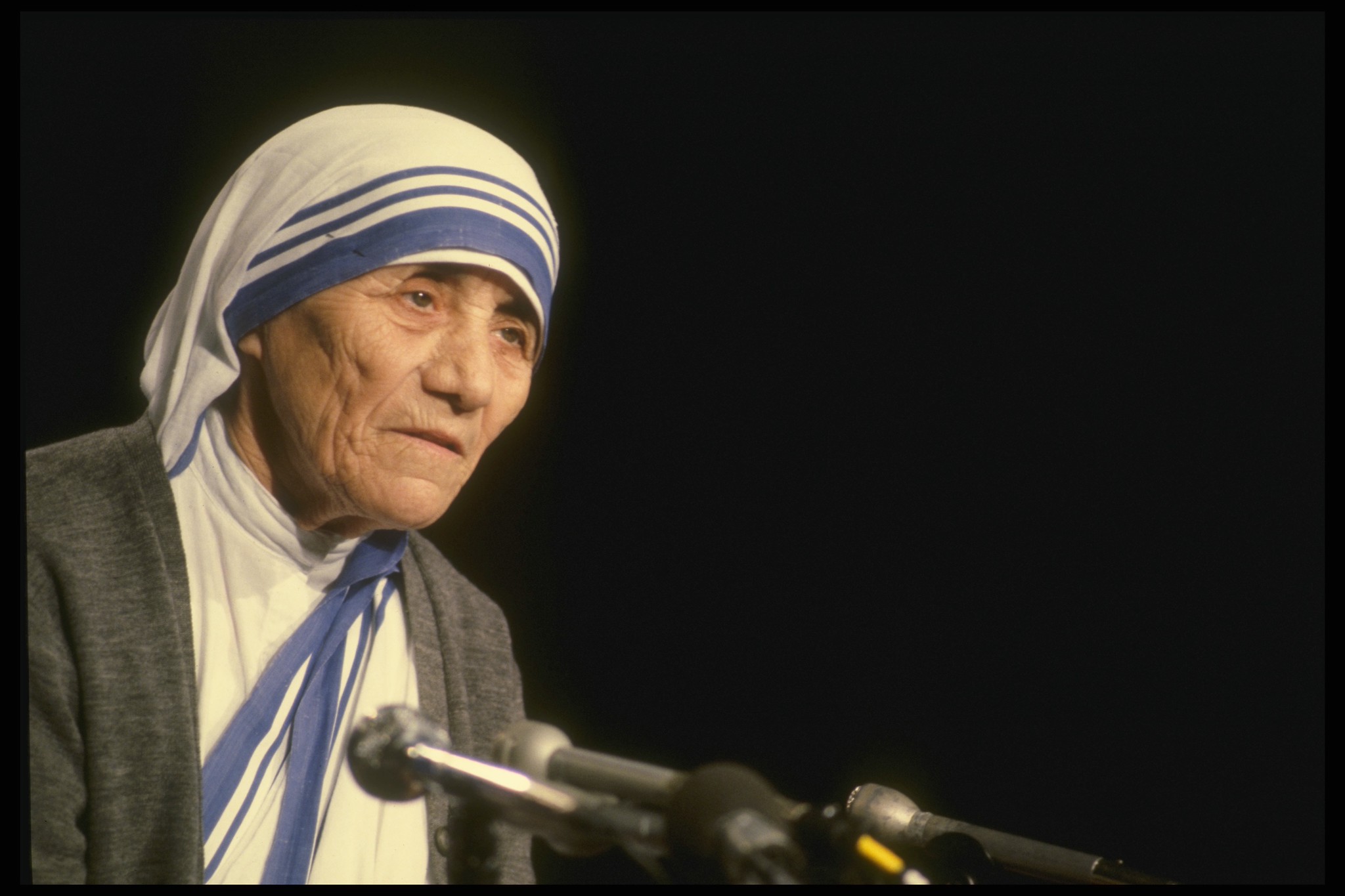 St. Teresa of Calcutta’s life offers a profound, living demonstration of Catholic Social Teaching in practice. Long before her canonisation, her work among the poorest of the poor embodied the Church’s radical call to uphold human dignity and stand in solidarity with the marginalised. While church teaching provides the intellectual and theological framework for justice, Saint Teresa provided its living heart, demonstrating how systemic principles must ultimately be lived out through personal, sacrificial love. Reflecting on her life alongside these core teachings shows how individual compassion and broad social duty are deeply intertwined.
Her life and ministry were a lesson in how we might strip away sentimentality, showing that Christian charity is far deeper and more demanding than superficial “niceness.”
Niceness too often seeks to maintain comfort and avoid tension. Thankfully, Saint Teresa intentionally stepped into environments of profound suffering, disease, and social rejection: the gutters of Kolkata (Calcutta, India), leper colonies, and hospices for the dying. For her, human dignity was not an abstract ideal; it meant physically touching, bathing, and holding people society considered untouchable. She proved that dignity is affirmed through uncomfortable, self-sacrificing presence, not polite distance.
While “being nice” lets us feel comfortable within our own social boundaries, relying heavily on warm feelings and favourable conditions. Teresa’s work challenged societal structures by exposing their failures. By creating the Missionaries of Charity, she forced a global audience to confront the human beings forgotten by economic and political systems. As many have highlighted, her practice of the Preferential Option for the Poor demands a radical shift in priorities: placing the most vulnerable at the absolute centre of moral concern rather than on the margins.
Posthumous collections (Come be my Light) of St. Teresa’s personal writings revealed that she spent decades experiencing severe spiritual isolation and inner darkness (the “dark night of the soul”). Despite feeling no emotional warmth or spiritual consolation, she maintained her gruelling daily routine of service for over forty years.
Like Christ defending His disciples, St. Teresa routinely bypassed administrative bureaucracy, social taboos, and conventional expectations to meet immediate human needs. For the individual Christian, this means moving beyond mere compliance: where niceness simply obeys rules to avoid conflict. A life formed by Catholic teaching boldly puts the living person first, choosing to defend human dignity and care for the soul even when it disrupts comfort, breaks social conventions, or risks disapproval.
In Luke, when the Pharisees question Jesus’ disciples for picking and eating grain on the Sabbath, Jesus defends them by invoking King David’s act of eating the sacred bread when his men were hungry. In doing so, Jesus establishes a profound principle at the heart of Catholic Social Teaching: religious tradition and social structures exist to serve human life, not to constrain compassion.
St. Teresa lived this principle with radical clarity. Just as Jesus refused to let rigid legalism obscure human hunger, Mother Teresa routinely cut through bureaucratic, social, and cultural barriers to reach people in immediate distress. For her, as within Catholic Social Teaching’s core pillar of Human Dignity, the living, breathing person in need took absolute precedence over administrative convenience or social convention. By declaring Himself “Lord of the Sabbath,” Jesus reframed holiness not as mechanical compliance to rules, but as an active, restorative love.
The encounter in Luke cuts directly to the core of what it means to honour human worth. When the Pharisees criticised the disciples, they were prioritising legalistic compliance over immediate physical suffering. Jesus’ response shattered the idea that structural rules take precedence over living human beings, revealing that every law, practice, and institution must ultimately serve, preserve, and lift up the individual person.
This dynamic forms the bedrock of Catholic Social Teaching, which asserts that every human life possesses an inherent, inviolable dignity rooted in being created in the image of God. Human worth is not earned through utility, economic productivity, or societal status, nor can it be stripped away by poverty, illness, or vulnerability.
Few people in modern history have embodied this truth as fiercely as St. Teresa. She did not view the destitute and dying of Kolkata as a social problem to be analysed from a distance, but as individuals of infinite value deserving of immediate, sacred care. Where the world saw “the unwanted, the unloved, and the uncared for,” she recognised the face of Christ. Just as Jesus refused to let Sabbath laws stand between a hungry person and food, Mother Teresa ignored social stigma, systemic neglect, and bureaucratic paralysis to walk in the gutter with those who were dying.
 It’s easy to see the nice old lady, whilst relegating her work and mission to the crowded gutters of 20th-century Kolkata. Yet her philosophy suggests that if she walked through the streets of Eastbourne today, her focus would remain unchanged.
Coastal communities often present a stark duality: picturesque seafronts and holiday charm masking deep-seated social challenges, such as seasonal poverty, isolation, addiction, housing insecurity, and quiet decay behind closed doors.
Saint Teresa frequently warned that the worst poverty isn’t always physical starvation, but the spiritual and emotional starvation of being forgotten. “The hunger for love is much more difficult to remove than the hunger for bread,” she observed, noting that affluent Western society often suffers from a profound poverty of loneliness.
If St. Teresa were to look at our local streets, at the elderly isolated in seaside flats, the unhoused sheltering from the coastal wind, or families struggling quietly behind faded facades, she would not call for grand ideological debates. She would ask a much simpler, more uncomfortable question: “Who is your neighbour right here?” Being a Christian in our own coastal backyard means recognising that human dignity isn’t just violated in far-off crises; it is tested by whether we choose to see or ignore the vulnerable walking along our own streets and promenades.
It is no coincidence that thousands will come together to defend the March for Life today (5 September 2026). Whether in large national rallies or quiet local witness along our own coastal streets, this movement echoes Mother Teresa’s relentless conviction that true charity refuses to stay silent while human dignity is compromised. Her life demonstrated that standing for the vulnerable is not a passive belief, but an active, visible duty. Gathering to defend life today challenges each of us to extend that same protective, sacrificial love to every human being, the unborn, the isolated, and the forgotten on our own doorsteps.
Ultimately, the encounter in Luke and the life of St. Teresa point us toward the same transformative truth: our personal faith is measured by how we treat the human person right in front of us. When Jesus reclaimed the Sabbath, He declared that no rule or system is higher than our duty to heal, restore, and preserve life. St. Teresa spent her life putting that declaration into practice, proving that living like Christ is not an abstract theory, but a radical daily commitment to see and serve Him in the vulnerable. By honouring the sacred dignity of every individual… through small, quiet acts of love, we can actively participate in the redeeming work of the Lord of the Sabbath and bring the Gospel alive in our own daily lives.


 Ordinariate of Our Lady of Walsingham
 Weekly news-sheet
 YouTube
 Facebook
 Christ the King with St Joachim